
Human Rights Day arrives each year with familiar commitments: dignity, equality, justice. But in Calcutta, where women and queer people navigate daily risks the system refuses to acknowledge, the day functions less as a celebration and more as a reality check.
At Anahat, we see this gap year-round. Our programmes — menstrual health in Odisha or learning to break gender discrimination in Jharkhand, gender-sensitisation in Sunderbans or leadership training with adolescents in Alipurduar– all reveal the same pattern: rights are only as strong as the environments people move through. And for many, those environments are hostile long before any headline-worthy violence occurs.

This is the landscape of hidden violence: the everyday behaviours, barriers and signals that restrict movement and dictate choices. It is the woman who picks her route based on street lampposts. The person in a crowded bus planning an exit strategy. The trans woman met with suspicion in public spaces. The elderly vendor who can’t access a toilet. The middle-class woman handling two full workloads — one paid, one expected.
None of these incidents show up in crime statistics. Most aren’t even spoken about. But they shape the lives, freedoms, health and opportunities of half the population.
The 2024 – 25 Maitree safety audit of public spaces across West Bengal confirms what these stories have always told us. Only a small fraction of respondents report feeling consistently safe; most say they feel safe only “sometimes” and many cannot say they feel safe at all. Fear is not abstract. Women and gender-diverse persons point to dark alleys, empty roads, crowded buses, markets and toilets as everyday sites of risk and describe a constant choreography of avoidance: changing routes, cutting short work or study, skipping opportunities, refusing night shifts or classes because the city will not protect them. Safety, they tell us, is not just the absence of violence, but freedom of movement, freedom from fear and access to facilities without having to ask permission.
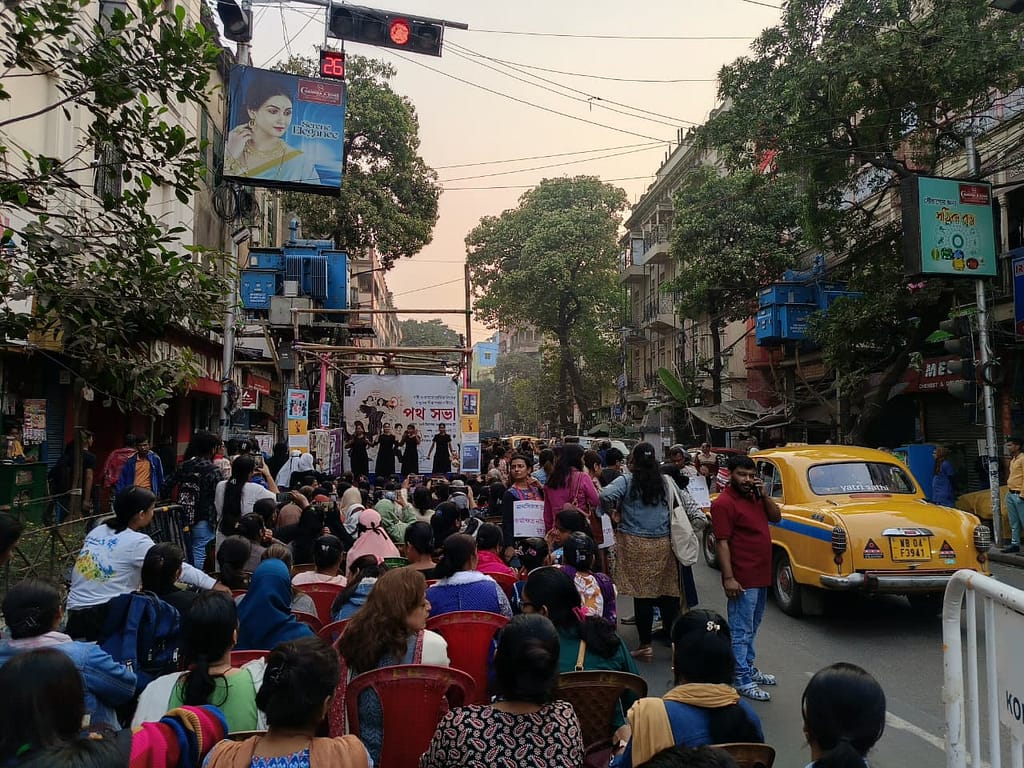

Human Rights Day forces an uncomfortable question: How meaningful is the promise of Rights when the conditions for exercising them don’t exist?
In response, during the 16 Days of Activism, Anahat launched a long-term project titled “Mapping Hidden Violence Map in Calcutta” a city-wide documentation project built from photos and statements submitted by women and queer residents. A bus stop where harassment is routine. A street that becomes unusable after dusk. A locked toilet. A discriminatory encounter. A workplace remark that was unsavoury. These fragments illustrate what official data leaves out: the structural nature of everyday harm.
Human Rights Day cannot remain symbolic. Rights are not abstract ideals found in civics textbooks: they depend on lighting, transport, toilets, accountability and non-discrimination. When these fail, Rights fail.

That is why this year, rather than asking the city to make statements, we are asking residents to provide evidence. Not for a courtroom, but for public truth-telling.
We are certain you, or someone you know, would have experienced some form of hidden violence. We ask you to capture it and send it across, for us to add to the map. Let Calcutta see what it has ignored for too long.
In the end, cities change only when they are forced to confront what they have ignored for too long. And nothing forces change like visibility.